Article: Kids' anti-UV T-shirt: skin protection without the bulk
Kids' anti-UV T-shirt: skin protection without the bulk
Key Takeaways
- Sunscreen doesn't last for a full day of exposure: clothing takes over for the areas it covers.
- UPF measures the protection of a textile, just like SPF for sunscreen.
- A UPF 50+ garment blocks the vast majority of UVA and UVB rays.
- An ordinary cotton t-shirt protects less than one might think, especially when wet.
- A well-designed UV-protective garment wears like regular clothing: comfortable fit, soft material, quick-drying.
- It is particularly useful for prolonged exposure: beach, boat, pool, cycling, water games.
Midday on the beach. The sun is directly overhead, with no shade to be found, and the children have no intention of leaving the water. This is exactly when their skin is most exposed, and it's also when sunscreen, applied earlier, may have lost some of its effectiveness: diluted by swimming, rubbed off by sand, towels, or friction.
It's in this interval, between applications, that clothing becomes a valuable protection. Not to replace sunscreen, but to provide lasting coverage for what sunscreen doesn't always protect long enough: shoulders, back, torso, arms, sometimes the neck, during long periods of exposure on a summer day.
UPF: The SPF of Textiles, Simplified
We know the SPF of sunscreens. Clothing, on the other hand, is measured in UPF, for Ultraviolet Protection Factor. This index indicates the amount of ultraviolet radiation that the fabric allows to pass through to the skin.
A UPF 50+ garment allows less than one-fiftieth of UV rays to pass through. In other words, it blocks more than 98% of ultraviolet radiation in the areas it covers. This is why the UPF index is an important guide when choosing clothing for long periods of sun exposure.
The immediate thought might be that an ordinary t-shirt is sufficient. In reality, a light-colored, thin, or loose cotton t-shirt protects less than one might imagine, and its protection can significantly decrease when wet. A UV-protective textile, however, is designed for this purpose: its material, weave, and density allow it to filter rays more effectively, even in water if specified by the manufacturer.
This is the whole difference between clothing that you wear and clothing that truly protects.
Protection That Wears Like Clothing
The real objection from parents remains: technical gear is often not very aesthetic, rigid, and children refuse to wear it. Everything then depends on appearance and comfort. A successful children's UV protection t-shirt should not look like an imposed medical or sports accessory: it should have a silhouette, a drape, a color, a real place in the summer wardrobe.
First, we look at the cut: long sleeves that cover the shoulders and arms without being tight, a sufficiently protective neckline, and a volume that moves with the child when they run, swim, or dive. Then the material: stretchy to never restrict movement, light on the skin, comfortable to wear wet or dry, and capable of drying quickly between swims.
A good UV-protective item makes you forget you're wearing it. That's its greatest quality.
Moments When It Changes Everything
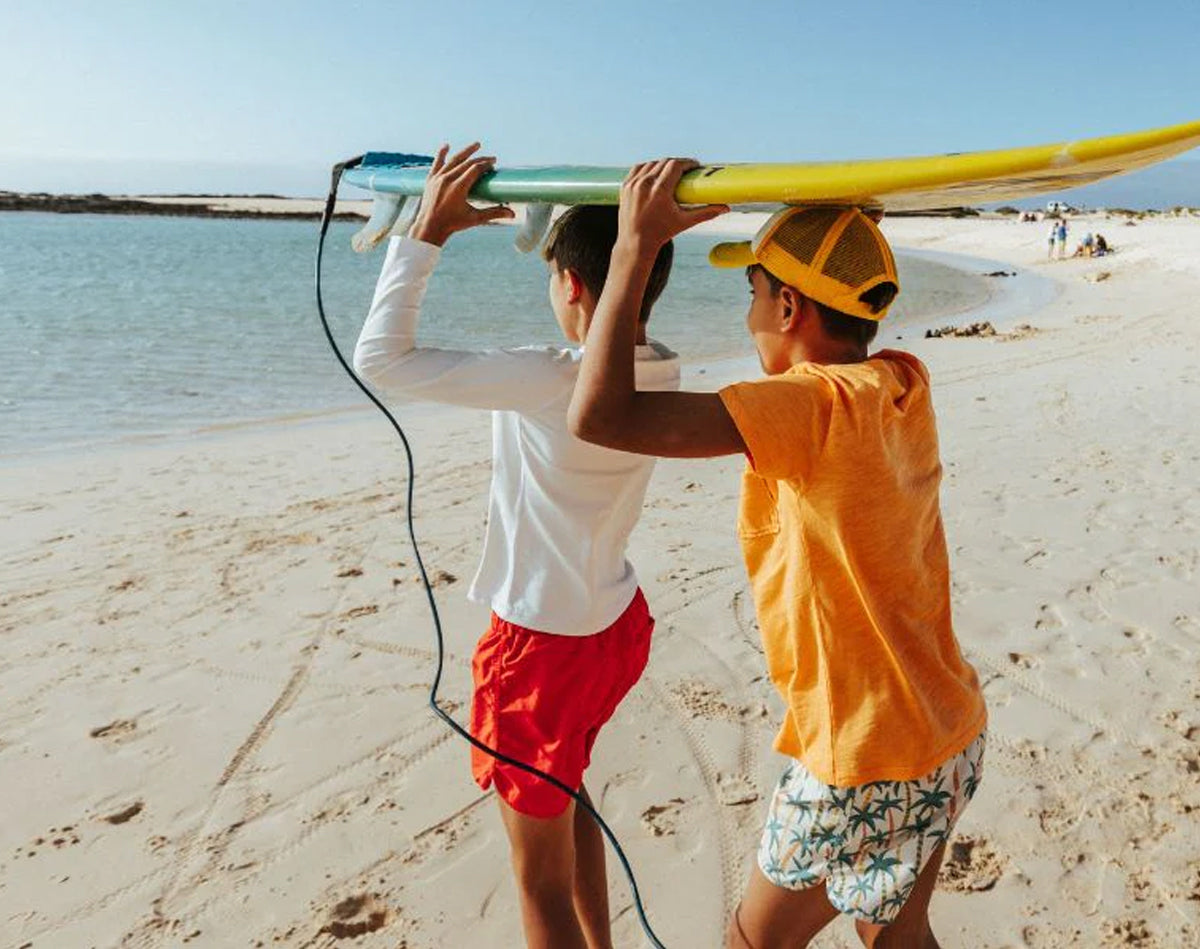
The UV-protective t-shirt is not meant to be worn from morning to night, over everything. It makes sense in situations of prolonged exposure, where shade is lacking and the child won't stay still: a whole day at the beach, a boat trip, a bike ride in direct sun, an afternoon at the pool, or long hours of playing in the water.
It becomes a particularly relevant reflex for fair skin, very young children, or children who burn easily. The idea is not to encourage prolonged exposure, but to reinforce physical protection when shade is lacking: to cover more, to depend less on urgent reapplication, and to let the child play more freely.
This reflex does not replace basic rules: avoid the strongest hours, seek shade, wear a hat, protect eyes with appropriate sunglasses, and apply sunscreen to all exposed areas.
At Sunchild: The Saco Line

It is precisely in this balance—protecting without restricting, covering without being bulky, equipping without sacrificing style—that Sunchild's Saco line is positioned.
Long-sleeved UV-protective t-shirts, designed to protect against UVA and UVB rays, made from a stretchy material that moves with you and dries quickly. But where technical equipment often stops at function, Saco adds the essential: style. Designed to go from the beach to a stroll, from swimming to an afternoon snack on the terrace, the line draws more from vacation wear than from technical gear.
The difference is first seen in the prints. The Big Wave print, palm trees, the surf spirit: designer patterns, the brand's signature, where ordinary UV protective clothing often settles for plain, unremarkable colors.
It is then evident in the colors. Obscur, Rivière, Petrol, Fanta: a palette designed like that of a real fashion piece, far from the conventional black and navy blue of the technical department.
The result: t-shirts that children want to wear, not just clothes that parents deem sensible. Because a garment worn with pleasure always protects better than a garment that has to be negotiated every morning. Protection, here, is not a compromise on style. It is part of it.
How to choose a good UV-protective t-shirt?
Before purchasing, a few criteria help distinguish a truly protective item from a simple beach garment:
- A clearly indicated UPF rating, ideally UPF 50+.
- Protection against both UVA and UVB rays.
- Protection maintained even when the fabric is wet, if the intended use includes swimming.
- Long sleeves to cover the shoulders and arms.
- A flexible, breathable, and comfortable material.
- Quick-drying between swims.
- Discreet seams to prevent chafing.
- A fit that the child accepts to wear without discomfort.
As often, the best garment is the one the child forgets they're wearing.
What This Says About Children's Fashion Today
The arrival of UV-protective clothing in the summer wardrobe reflects a broader trend. A generation of parents no longer wants to choose between protecting, ensuring durability, and looking good: they expect all three at once.
Skin care meets the demand for quality materials, user comfort, and well-designed pieces. The UV-protective t-shirt, long confined to the sports section, thus enters the wardrobe as a complete essential.
A sign, perhaps, that dressing children is no longer opposed to protecting them.
In Summary
A wardrobe designed to accompany childhood, not constrain it, even in how it allows children to run, play, and grow in the sun.
Frequently Asked Questions
From what age can a child wear a UV-protective t-shirt?
From the first years of life. For babies and very young children, clothing is one of the most useful physical protections, along with shade, a hat, and sunglasses. The goal, however, remains to avoid direct and prolonged exposure, especially during peak hours.
Should sunscreen still be used with it?
Yes. The t-shirt only protects the areas it covers. Sunscreen remains essential for the face, ears, hands, legs, feet, neck, and all exposed parts. The two protections are complementary.
Does a UV-protective t-shirt still protect when wet?
A UV-protective textile designed for swimming is specifically engineered to maintain its protection in water. This is an important difference from a classic cotton t-shirt, whose protection can decrease when soaked. Always check the manufacturer's instructions.
What is the difference from a classic cotton t-shirt?
The weave, density, and material. A UV-protective garment is designed to filter more ultraviolet radiation, with a measured protection index. A light-colored, thin, or stretched cotton t-shirt can let through much more radiation than one might imagine.
UPF 30, 40 or 50: which one to choose?
The higher the index, the greater the protection. For prolonged summer exposure—beach, pool, boat, or water games—a UPF 50+ is generally the most protective choice. The main thing is also to adequately cover the most exposed areas.
How to care for a UV-protective t-shirt to maintain its protection?
Gentle washing at 30°C, air drying, and avoiding harsh products, such as certain fabric softeners, help preserve the textile's qualities. The safest approach is to follow the recommendations on the garment's label.